July 10, 2026
Technical Analysis of Ceramic Pot Weather Resistance: Garden Ceramic Engineering Standards from Glaze Formula, Frost Resistance to Indoor and Outdoor Universal Use
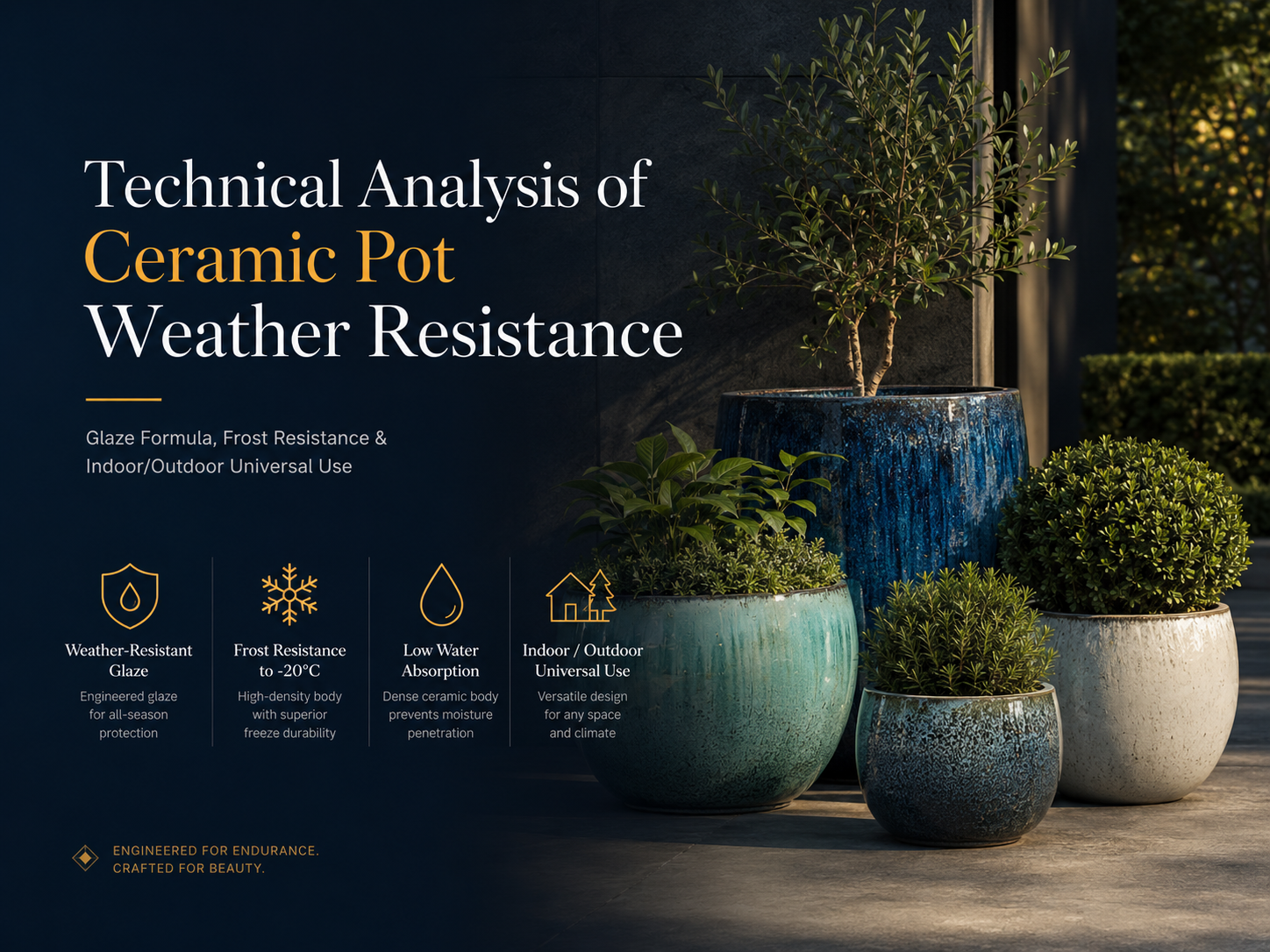
Table of Contents
1. Introduction to Weather Resistance of Modern Garden Ceramic Pots
2. Core Foundation: Scientific Glaze Formula for Ceramic Pots
3. Frost Resistance Mechanism and Practical Performance Standards
4. Indoor and Outdoor Universal Adaptability Engineering Analysis
5. Performance Data Comparison of Different Ceramic Pot Configurations
6. Standardized Application Guidelines for Garden Ceramic Projects
7. Industry Frequently Asked Questions
1. Introduction to Weather Resistance of Modern Garden Ceramic Pots
Ceramic pots are the most widely used planting containers in residential gardens, commercial landscapes and indoor greening projects.
Ordinary low-quality ceramic products are prone to cracking, peeling and fading under long-term outdoor natural erosion.
Weather resistance has become the core evaluation index of high-standard garden ceramic engineering.
It mainly depends on three core technical indicators: optimized glaze formula, stable frost resistance and mature indoor and outdoor universal adaptation technology.
2. Core Foundation: Scientific Glaze Formula for Ceramic Pots
2.1 Influence of Glaze Formula on Overall Performance
The surface glaze layer is the first protective barrier ofceramic pots against external environmental erosion.
Unreasonable glaze ratio will lead to poor air tightness and water permeability of the pot body.
It directly reduces the overallweather resistance and shortens the service life of garden ceramics.
2.2 High Weather Resistance Glaze Optimization Technology
Professional garden ceramic glaze formula adds high-purity quartz and feldspar components.
It forms a dense glass protective layer after high-temperature firing above 1280℃.
This structure can effectively resist ultraviolet radiation, rain erosion and temperature alternating impact.
Avoids glaze fading, peeling and powder falling in long-term outdoor exposure environments.
3. Frost Resistance Mechanism and Practical Performance Standards
3.1 Damage Principle of Low Temperature to Ceramic Pots
Outdoor soil and residual moisture will freeze and expand in low temperature winter environment.
Ordinary ceramic blanks have high water absorption, which is easy to cause internal cracking after water freezing.
Frost resistance is the key technical threshold for garden ceramics to adapt to temperate and frigid zone climates.
3.2 High Standard Frost Resistance Technical Control
High-quality ceramic pots adopt low water absorption blank forming technology.
Cooperate with closed glaze formula to isolate external moisture penetration.
After professional freeze-thaw cycle test, the pot body keep intact without cracking or deformation.
It can stably adapt to -20℃ low temperature environment in winter.
4. Indoor and Outdoor Universal Adaptability Engineering Analysis
4.1 Environmental Differences Between Indoor and Outdoor Scenarios
Indoor environments feature stable temperature and humidity, no strong wind and ultraviolet erosion.
Outdoor environments face extreme weather such as high temperature, heavy rain, frost and strong light.
Most single-scene ceramic pots cannot take into account the dual environmental adaptation needs.
4.2 Core Advantages of Indoor and Outdoor Universal Design
Indoor and outdoor universalceramic pots integrate high weather resistance and ornamental performance.
The high-density glaze layer ensures no fading and no cracking for outdoor long-term use.
Exquisite firing texture and diverse appearance also meet indoor home decoration aesthetics.
Greatly improve the flexibility of garden engineering and soft outfit design.
5. Performance Data Comparison of Different Ceramic Pot Configurations
The following test data refers to the European EN 15250 garden ceramic product performance standard, which objectively compares the weather resistance and comprehensive performance of different ceramic pot products.
Ceramic Pot Type | Glaze Formula Process | Water Absorption Rate | Frost Resistance Limit | Weather Resistance Service Life | Applicable Scenario |
Ordinary Low-Temperature Ceramic Pot | Low-temperature ordinary glaze | 8.2% | 0℃ | 1-2 Years | Only Indoor |
Medium-Grade Garden Ceramic Pot | Conventional high-temperature glaze | 4.5% | -10℃ | 3-5 Years | Semi-Outdoor |
High-Quality Universal Ceramic Pot | Optimized dense weather-resistant glaze | 1.2% | -20℃ | 8-10 Years | Indoor and Outdoor Universal |
Data proves that optimized glaze formula is the core to reduce water absorption and improve frost resistance.
Only products with excellent weather resistance performance can realize real indoor and outdoor universal engineering application.
6. Standardized Application Guidelines for Garden Ceramic Projects
First, select high-temperature fired ceramic pots with professional weather-resistant glaze for landscape engineering.
Second, verify the frost resistance grade according to the local minimum winter temperature.
Third, unified adopt indoor and outdoor universal specifications to reduce project material classification cost.
This standard matching method can maximize the service life of garden ceramic products.
7. Industry Frequently Asked Questions
Q1: What is the main factor affecting the weather resistance of ceramic pots?
A1: The glaze formula and firing process are the core factors. Dense high-temperature glaze can isolate water and ultraviolet rays, fundamentally improving the weather resistance and frost resistance of ceramic pots.
Q2: Can indoor ordinary ceramic pots be directly used outdoors?
A2: Not recommended. Ordinary indoor pots have high water absorption and poor frost resistance. They are easy to crack and peel in outdoor low temperature and rainy weather, with very short service life.
Q3: What temperature range can frost-resistant ceramic pots adapt to?
A3: High-standard garden ceramic pots can withstand -20℃ low temperature freeze-thaw cycle test, suitable for most temperate and subtropical outdoor garden scenarios.
Q4: What are the advantages of indoor and outdoor universal ceramic pots in engineering projects?
A4: It unifies material standards, reduces procurement and management costs, and avoids product quality difference caused by scenario classification. It is the mainstream choice of modern garden landscape engineering.