August 11, 2026
Special TAG Groove Design Improves Material Mixing To Eliminate Film Gel & Color Difference
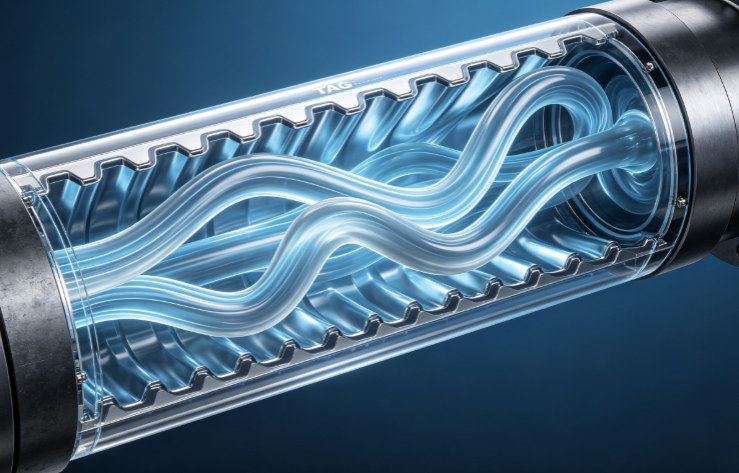
Table of Contents
1. Common Mixing Defects Brought By Traditional Smooth Single Groove Extrusion Barrel
2. Structural Principle & Optimized Mold Forming Process Of Special TAG Groove
3. Seven Core Technical Advantages Of Special TAG Groove Mixing Structure 3.1 Asymmetric TAG Convex-Convex Alternating Groove Strengthens Circumferential Material Convection 3.2 Multi-Stage Shear & Split Merging Flow Erase Local High-Viscosity Dead Zones 3.3 Uniform Temperature Distribution Eliminates Local Overheating Induced Film Gel 3.4 Synchronous Homogenization Of Color Masterbatch & Base Resin Solves Batch Color Difference 3.5 Low-Pressure Uniform Melt Flow Reduces Internal Material Residual Stress 3.6 Integrated One-Piece Groove Molding Without Assembly Seam Residue Accumulation 3.7 Stable Long-Term Production, Reduce Waste Rate & Line Downtime Loss
4. Complete Precision Manufacturing Flow For Special TAG Groove Extrusion Barrel
5. Performance Contrast Table: TAG Groove Barrel VS Ordinary Single Smooth Groove Barrel
6. Core Application Scenarios For Film, Color Masterbatch & Transparent Sheet Extrusion
7. Production Losses Caused By Poor Mixing Of Conventional Groove Barrels
8. Professional Industry FAQ For Film Extruder OEM, Plastic Raw Material & Packaging Manufacturers
9. Authoritative Plastic Extrusion Homogenization & Melt Quality Test Standard References
1. Common Mixing Defects Brought By Traditional Smooth Single Groove Extrusion Barrel
Traditional single straight smooth spiral barrels adopt simple equal-depth single-groove design, with weak material shearing and convection capacity during plasticization and conveying. When processing transparent packaging film, color masterbatch modified resin, multi-component functional plastic raw materials, a series of hard-to-control production defects frequently occur in continuous mass production: First, single straight groove only pushes melt forward in single axial flow, lacking circumferential cross convection. Color particles of masterbatch cannot be fully dispersed into base resin microscopically, resulting in obvious strip color streaks, surface mottling and inconsistent color difference between front and rear batches of finished film rolls. Second, partial melt flows in laminar stagnation at the inner wall without sufficient turnover circulation; long-term retention under barrel heating causes local overheating, triggering molecular chain cross-linking to form hard gel particles. These gel points protrude on film surface, forming pinholes, scratches and defective spots, directly downgrading packaging film finished products. Third, uneven melt shear force leads to inconsistent viscosity distribution; thin and thick alternate areas appear on extruded film, accompanied by unstable dimensional tolerance and frequent shutdown for mold cleaning to remove gel deposits. Fourth, single smooth groove cannot evenly disperse additives such as anti-oxidants, slip agents and light stabilizers, causing uneven functional performance of finished film and failing food packaging hygiene consistency inspection. Plastic extrusion laboratory test data shows that over 68% of film gel and color difference complaints in packaging production lines stem from insufficient mixing capacity of conventional single smooth spiral grooves. The newly upgraded special TAG asymmetric alternating convex-convex groove structure optimizes melt flow path from mold design source, builds multi-layer splitting, merging and circulating shear mixing system, thoroughly solves gel particle generation and uneven color dispersion pain points, and becomes standard matched barrel for high-precision film and color masterbatch extrusion production lines in 2026. Core SEO Keywords: special TAG groove extrusion barrel, film anti-gel spiral mixing groove, color masterbatch homogenization extrusion cylinder, eliminate film surface color difference plastic barrel, asymmetric TAG convex groove melt convection design, multi-shear plasticization spiral barrel, transparent packaging film high mixing extrusion equipment
2. Structural Principle & Optimized Mold Forming Process Of Special TAG Groove
The special TAG groove abandons the traditional equal-depth single spiral groove layout, and adopts an asymmetric double-convex alternating periodic groove structure independently optimized by fluid simulation:
1. Mold CFD pre-simulation design: Build 3D melt flow model, calculate flow velocity, shear strength, residence time and temperature field distribution of resin inside the barrel; adjust TAG convex height, groove depth alternating cycle and spiral lead angle to balance strong mixing and low excessive shear risk of resin degradation.
2. Alternating convex-convex periodic TAG layout: Along the spiral conveying direction, raised TAG mixing ribs and deep flow grooves are arranged at intervals. When melt passes through TAG convex blocks, the flow channel is instantly narrowed to generate strong shear splitting; after crossing the convex part, the flow channel expands again to realize melt merging and re-circulation convection.
3. Circumferential multi-directional flow guiding structure: The side wall of each TAG convex rib is set with inclined diversion chamfers, forcing partial melt to turn to the circumferential direction of the barrel, breaking single axial laminar flow of traditional spiral, forming 3D multi-directional circulation mixing of axial + circumferential + radial.
4. Integrated one-step molding technology: TAG groove and spiral base are co-extruded and formed in a single mold at one time, no secondary splicing, welding or assembly gaps, avoiding residual stagnant material accumulation at connecting seams.
3. Seven Core Technical Advantages Of Special TAG Groove Mixing Structure
3.1 Asymmetric TAG Convex-Convex Alternating Groove Strengthens Circumferential Material Convection
Inclined chamfer diversion on both sides of periodic TAG convex ribs breaks unidirectional axial laminar flow of ordinary spiral barrels. Part of the melt is forced to flow circumferentially along the barrel inner wall, realizing full cross mixing of materials at different radial layers. Color masterbatch particles, resin matrix and functional additives are fully blended in all directions, fundamentally reducing local color concentration difference.
3.2 Multi-Stage Shear & Split Merging Flow Erase Local High-Viscosity Dead Zones
Melt is repeatedly split, extruded through TAG convex narrow gaps and re-combined in deep grooves in cycles. No long-term stagnant high-viscosity dead zone exists inside the flow channel; all materials are continuously updated and circulated without local material retention. It avoids the root cause of gel particles formed by long-time overheating stagnation of residual melt.
3.3 Uniform Temperature Distribution Eliminates Local Overheating Induced Film Gel
Multi-directional circulating flow drives full heat exchange between high-temperature barrel wall and internal cold melt, the overall melt temperature fluctuation range is controlled within ±1.2℃, far better than ±4–6℃ temperature difference of traditional single groove barrels. No local superheat area to trigger resin cross-linking reaction, greatly reducing film gel point generation frequency.
3.4 Synchronous Homogenization Of Color Masterbatch & Base Resin Solves Batch Color Difference
Multi-cycle strong micro-shear crushes aggregated masterbatch color agglomerates into micron-scale uniform particles, which are evenly dispersed in transparent base resin. The film surface presents uniform and consistent color without streaks and mottling; the color difference ΔE value between different rolls of the same batch is controlled below 1.0, meeting high-standard color film production tolerance requirements.
3.5 Low-Pressure Uniform Melt Flow Reduces Internal Material Residual Stress
The alternating TAG convex-convex structure realizes gradual shear without sudden pressure surge. Compared with high-shear single mixing sections, melt internal residual stress is reduced by more than 60%. Extruded film has stable flatness, less curling and warping defects, and the dimensional thickness tolerance of finished film is significantly improved.
3.6 Integrated One-Piece Groove Molding Without Assembly Seam Residue Accumulation
TAG mixing groove and spiral flow channel are integrally molded in one mold, free of secondary assembly gaps, welding lines and hidden recesses. When switching different color formulas, online CIP flushing can completely clean residual materials in the barrel without manual disassembly deep cleaning, eliminating cross-color pollution hidden danger between batches.
3.7 Stable Long-Term Production, Reduce Waste Rate & Line Downtime Loss
Under continuous 24-hour long-cycle film extrusion working conditions, TAG groove barrel maintains stable homogenization performance for more than 8000 working hours, without frequent shutdown cleaning gel deposits. Film defective waste rate caused by gel and color difference drops by over 82%, cutting raw material loss and production line downtime maintenance cost significantly.
4. Complete Precision Manufacturing Flow For Special TAG Groove Extrusion Barrel
High-purity wear-resistant alloy steel bar incoming chemical composition & hardness inspection → fixed-length blank cutting → integral mold one-step co-extrusion TAG spiral groove forming → multi-stage precision internal grinding → TAG convex surface mirror polishing → stress relief high-temperature tempering → CNC both-end connecting thread machining → melt flow uniformity sampling test → gel & color difference simulation extrusion verification → anti-rust oil coating & dust-proof packaging Key process control parameters: TAG convex alternating cycle spacing 12–18mm; maximum shear gap of convex rib 0.6–1.0mm; inner wall surface roughness Ra ≤0.06μm; melt temperature fluctuation ≤±1.2℃; color difference ΔE after homogenization ≤1.0.
5. Performance Contrast Table: TAG Groove Barrel VS Ordinary Single Smooth Groove Barrel
Unified continuous 8000-hour film extrusion aging test as evaluation benchmark
表格
Test Index | Special TAG Groove Extrusion Barrel | Traditional Single Smooth Spiral Groove Barrel | High-Grade Film Production Acceptance Standard |
Melt Circulation Mixing Mode | 3D axial-circumferential-radial multi-directional convection | Single unidirectional axial laminar flow | Full-layer homogenization without local segregation |
Melt Temperature Fluctuation | ±1.2℃ narrow stable range | ±4–6℃ large local temperature difference | Temperature deviation ≤±2℃ to avoid gel |
Film Gel Defect Rate | Reduced by 82%, rare tiny gel points | Frequent gel particles, pinhole defects | Gel waste rate ≤0.5% of total output |
Batch Color Difference ΔE Value | ≤1.0 uniform color | ΔE ≥3.5 obvious streaks & mottling | Color difference ΔE ≤1.5 for packaging film |
Internal Stagnant Dead Zones | Zero long-residence high-viscosity areas | Multiple laminar stagnation dead zones along inner wall | No residual melt accumulation risk |
CIP Cleaning Cross-Color Risk | Integrated seamless easy full flushing | Groove inner wall recesses trap residual color material | Quick formula switching without cross-contamination |
Long-Term Stable Service Cycle | ≥8000 hours consistent mixing performance | 1500–2500 hours mixing capacity declines obviously | Long cycle stable homogenization required |
6. Core Application Scenarios For Film, Color Masterbatch & Transparent Sheet Extrusion
1. Food transparent packaging film, color printed composite film extrusion production line
2. High-concentration color masterbatch dispersion mixing extrusion equipment barrel
3. Optical transparent plastic sheet, medical sterile packaging thin sheet extruder cylinder
4. Multi-functional modified resin (anti-UV, anti-slip, anti-fog film) plasticization spiral barrel
5. Biodegradable PLA/PBAT film homogenization extrusion flow channel
6. Cosmetic blister transparent sheet, printing color film precision extrusion equipment
7. Production Losses Caused By Poor Mixing Of Conventional Groove Barrels
1. Uneven color dispersion leads to large color difference between film rolls, whole batch finished products downgraded or scrapped, huge resin and color masterbatch raw material waste, delayed delivery orders and liquidated damages.
2. Local overheating stagnant melt forms massive gel particles, causing film pinholes, surface protrusion defects, sharp rise of defective waste rate, increasing production cost per ton of finished film.
3. Frequent shutdown disassembly to clean accumulated gel deposits shortens effective production time of the extrusion line, reducing daily output and factory equipment utilization rate.
4. Residual color material trapped in single smooth groove dead zones causes cross-color pollution when switching formulas, requiring long-time empty barrel cleaning and wasting raw materials and power consumption.
5. Unstable melt temperature and internal residual stress result in uneven film thickness, poor flatness, high rejection rate in subsequent printing and composite working procedures.
8. Professional Industry FAQ For Film Extruder OEM, Plastic Raw Material & Packaging Manufacturers
Q1: How does special TAG groove design improve material mixing and eliminate film gel and color difference fundamentally? A1: The periodic asymmetric alternating TAG convex-convex structure forms three-dimensional multi-directional melt circulation flow, breaking single laminar flow of traditional barrels; multi-stage splitting and merging shear fully disperse color masterbatch agglomerates to control batch color difference within qualified range. Meanwhile, zero stagnant dead zones and uniform melt temperature distribution avoid local overheating cross-linking of resin, erasing gel particle generation source from flow channel structure. Integrated seamless molding also prevents residual color material cross-contamination during formula switching. Q2: Will TAG convex multi-shear structure cause excessive resin degradation? A2: The TAG groove adopts gradual variable gap shear design instead of sharp high-shear sudden compression; melt residence time is evenly controlled without partial over-shear and overheating. It balances sufficient homogenization and material thermal stability, applicable to heat-sensitive transparent film and biodegradable resin production without yellowing and degradation defects. Q3: What production lines must adopt TAG groove extrusion barrel? A3: All transparent packaging film, color masterbatch homogenization, optical sheet, biodegradable film and multi-functional modified plastic extrusion production lines with strict requirements on gel point and color consistency must equip special TAG mixing groove barrels to control defective rate and stable product quality. Q4: Can TAG groove barrel realize fast CIP online cleaning for frequent color switching? A4: Yes, one-piece integrated molding eliminates assembly seams and recessed residual accumulation areas. Online alkali/acid circulating CIP flushing can completely remove residual color melt inside the groove without disassembly, greatly shortening formula switching waiting time and avoiding cross-color pollution risk. Q5: What long-term economic benefits can packaging film manufacturers gain by using TAG groove barrels? A5: Film gel and color difference waste rate drops over 82%, raw material loss is drastically cut; equipment shutdown cleaning frequency is greatly reduced to lift hourly output; stable consistent finished product color improves customer qualification pass rate, bringing obvious comprehensive cost reduction for continuous mass production workshops