July 10, 2026
High-End Daily Ceramic Tableware Buying Guide: A Purchasing Decision Framework Covering Glaze Quality, Food Safety Certification and Firing Process
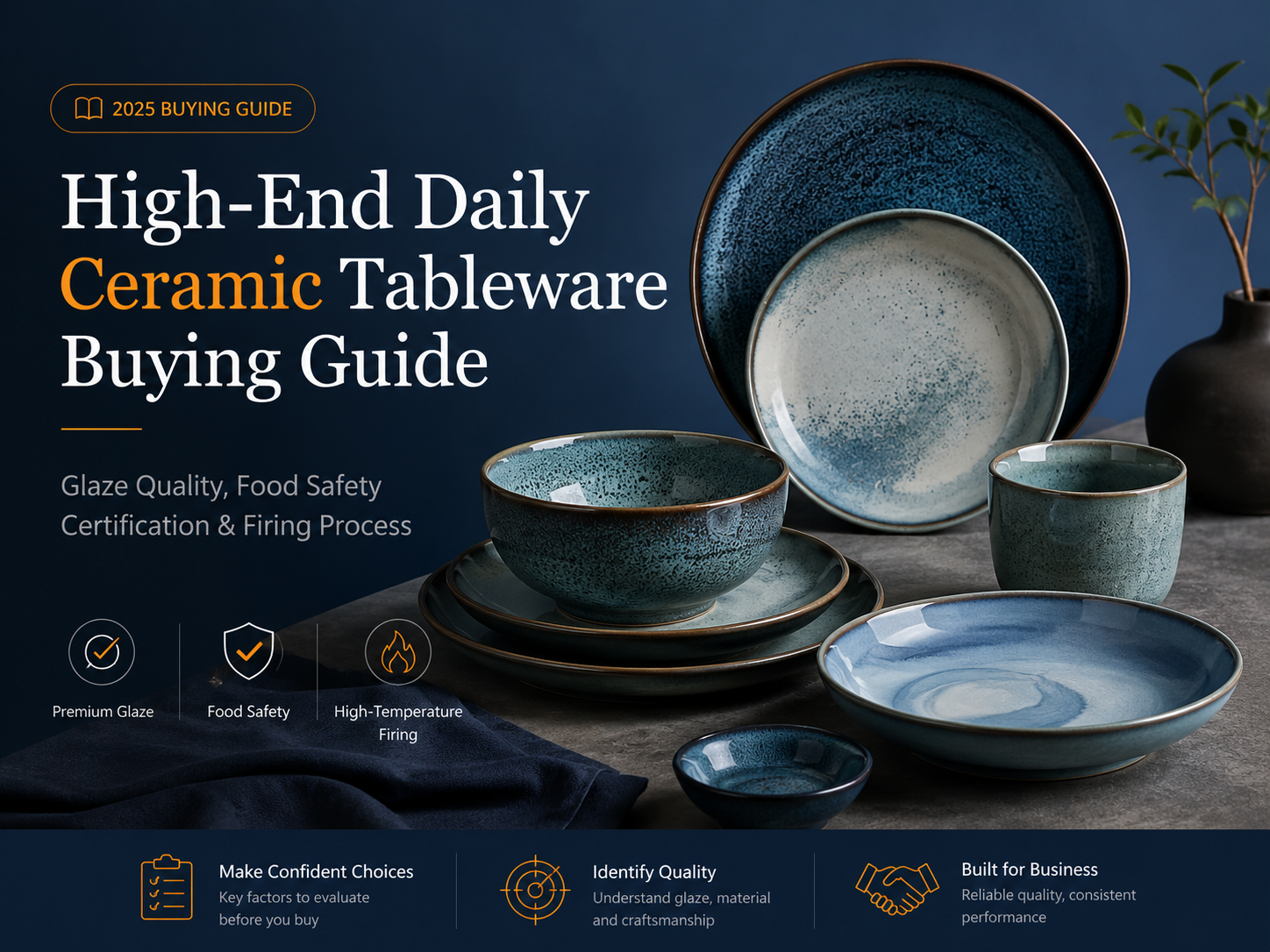
Table of Contents
1. Overview of Premium Ceramic Tableware Market
2. Glaze Quality Identification and Core Standards
3. Firing Process Classification and Quality Impact
4. Food Safety Compliance for Ceramic Tableware
5. Scientific Purchasing Decision Framework for Bulk Buyers
6. Process & Quality Industry Comparison Data
7. Industry Frequently Asked Questions
1. Overview of Premium Ceramic Tableware Market
High-end ceramic tableware is widely used in high-star hotels, luxury catering and upscale household scenarios. Different from ordinary ceramic products, it has stricter requirements on appearance, durability and safety.
Many buyers only judge products by surface texture and price. They ignore internal firing process and food safety indicators, that leads to batch return and brand risk.
According to 2025 global ceramic consumer goods industry report, nearly 26% of low-grade ceramic tableware fail heavy metal detection, mostly caused by unqualified glaze and incomplete firing.
2. Glaze Quality Identification and Core Standards
Glaze quality is the most intuitive evaluation index of high-end ceramic tableware. It affects not only aesthetics, but also daily anti-fouling performance and food contact safety.
2.1 Visual and Tactile Screening Method
Qualified high-end glaze shows uniform luster, no tiny pinholes, no cracks and no uneven color difference. The surface feels smooth without granular protrusions.
Inferior glaze often has hidden tiny pores. These pores easily hide oil stains and breed bacteria, which cannot be completely cleaned in daily washing.
2.2 Functional Performance of High-Quality Glaze
Premium ceramic glaze adopts high-temperature fused formula. It owns strong corrosion resistance and will not fade or fall off after long-term use and high-temperature disinfection.
Low-quality glaze layer is thin and unstable. It is prone to peeling when encountering high temperature and acidic food, causing potential safety hazards.
3. Firing Process Classification and Quality Impact
Firing process determines the density, structural stability and safety limit of ceramic tableware. It is the core hidden factor that distinguishes high-end products from ordinary products.
3.1 Low-Temperature vs High-Temperature Firing
Low-temperature firing is usually below 1100℃. The ceramic body is loose, and the glaze layer cannot be fully fused. Heavy metal precipitation risk is relatively high.
High-end daily ceramic tableware adopts high-temperature firing above 1280℃. The body and glaze are fully sintered, with dense texture and extremely low dissolution risk.
3.2 Process Consistency Control
Stable firing temperature and holding time ensure batch product consistency. Many small factories have unstable furnace temperature, resulting in uneven quality in the same batch.
Even with the same raw materials, different firing parameters will form completely different finished product performance.
4. Food Safety Compliance for Ceramic Tableware
Food safety is the bottom-line standard for high-end ceramic tableware export and commercial use. All products must pass authoritative food contact material testing.
4.1 Key Detection Indicators
Lead and cadmium precipitation are the core detection items. High-quality tableware controls heavy metal dissolution far below international standard limits.
Acid and alkali resistance test is also essential. It ensures safety when contacting vinegar, fruit acid and high-temperature hot soup.
4.2 Authoritative Certification Requirements
Global mainstream sales markets require FDA, LFGB or ISO food safety certification. Products without complete certification cannot enter high-end commercial scenarios.
Many cost-effective products lack formal certification documents, which will become a major obstacle for brand sales and customs clearance.
5. Scientific Purchasing Decision Framework for Bulk Buyers
Professional procurement decisions should avoid single price competition. It needs to comprehensively evaluate glaze quality, firing process and food safety qualification.
5.1 First Step: Safety Qualification Verification
Check complete food safety test reports and certification files first. Eliminate unqualified batches at the source to avoid subsequent compliance risks.
5.2 Second Step: Process and Appearance Inspection
Verify high-temperature firing process parameters, and sample check glaze flatness, luster and integrity to ensure consistent high-end texture.
5.3 Third Step: Batch Stability Evaluation
Evaluate factory production stability and after-sales capability. Long-term stable quality is more important than one-time low price advantage.
6. Process & Quality Industry Comparison Data
The following comparison data comes from 2025 International Ceramic Tableware Quality Test Report, which clearly shows the quality gap of different processes.
Product Grade & Firing Process | Glaze Defect Rate | Heavy Metal Qualified Rate | Acid-Base Resistance | Batch Consistency |
Low-Temperature Ordinary Ceramic | 8.7% | 74.2% | Weak | General |
Medium-Temperature Standard Ceramic | 3.2% | 92.5% | Medium | Good |
High-Temperature High-End Ceramic | 0.6% | 99.8% | Excellent | Superior |
7. Industry Frequently Asked Questions
Q1: What is the biggest difference between high-end ceramic tableware and ordinary tableware?
A1: The core difference is firing temperature and glaze formula. High-temperature firing ensures dense body and safe glaze, while ordinary products have hidden safety and durability risks.
Q2: Is glossy glaze necessarily better than matte glaze?
A2: Not exactly. Both can reach high-end standards. The key is glaze density and firing quality, not surface gloss style.
Q3: Why food safety certification is necessary for ceramic procurement?
A3: Uncertified products may have excessive heavy metal precipitation. It will cause market recall and legal risks for commercial buyers.
Q4: How to quickly judge qualified firing process?
A4: High-fired ceramic has compact texture, clear sound when knocked, no water absorption and stable glaze color, which is obviously different from loose low-temperature ceramic.